Control vs Communication – The choice your horse is begging to make.
I’ve had some really eye-opening conversations at recent events — and they’ve reminded me just how many people are still stuck in the mindset of controlling their horses, rather than training or better yet, communicating with them. And I get it. That’s what many of us were taught. But the more I’ve learned, the more I’ve come to realise: there’s a much better way.
1. A Willing Horse is Worth More Than an Obedient One
At the end of the day, isn’t it better to have a horse who wants to walk with you? One who comes when called, stands calmly for the vet, and trusts that you’ve got their back? You don’t get that through control. You get it through time, understanding, and consistent, kind training.
2. Tiny Moments Build Big Trust
I’m not talking about hours in an arena or complicated exercises. I’m talking about small, simple moments of clarity, where the horse gets a chance to figure things out in their own time. That builds confidence and trust. And it starts by learning to listen — not just to what they do, but to what they’re trying to tell us.
3. They’re Not Stubborn – They’re Processing
I’ve been diving into the world of donkeys recently, thanks to the Donkey Sanctuary, and something that really stuck with me was the idea of the “Donkey Minute.” It’s the time they need to assess a situation. Sometimes it’s a minute. Sometimes it’s 30. Horses need that time too. That pause where they’re deciding: is this safe? Am I okay? If we rush them, we rob them of the chance to say yes on their own terms.
4. Ears Back Isn’t Anger – It’s Survival
When I was learning years ago, there was barely any talk about horse psychology. All I remember was “ears back = get out of the way!” Now I understand: those ears are part of their survival. When they feel threatened, they put them back to protect them. It’s not personal. It’s instinct. (If you’re curious to know more, I really recommend the webinar Understanding Horses and Interpreting Wild Horse Behaviour).
5. Ask “Why?” Not “How Do I Stop It?”
One conversation stuck with me at a show. Someone told me they use rope halters because their horse is big and strong and otherwise people get “dragged around.” My heart sank. Not because she was doing anything wrong — but because I’ve been there. Instead of asking, “What can I use to stop this horse?” maybe the better question is, “Why is the horse trying to leave in the first place?” Are they worried? Confused? In pain?
6. The Tool is Only as Kind as the Hands That Use It
Rope halters can apply pressure, but that’s not the point. They’re about feel. They’re tools for communication, not control. Like bits, whips, or spurs, anything can become harsh in the wrong hands. But in the right hands, a rope halter becomes a subtle, kind, and incredibly effective tool. That’s why I always recommend pairing them with horsemanship training that builds trust, not compliance.
7. Your Energy Speaks Louder Than Your Aids
With most rope halters, there’s no metal between you and the horse. They feel everything through that rope. Your energy, your intention, your state of mind, before you’ve even moved. They can sense your heartbeat from about 4 feet away! Before you arrive at the stables, take a moment to breathe and check in with yourself. How are you feeling?
I should say: I’m not a professional trainer. My early training was in teaching (35 years ago!), and while I haven’t done extensive horsemanship work, I’ve spent the last 15 years quietly observing and learning from horses — especially the beautiful Arabs of my sister-in-law.
I’ve seen how the right kind of handling, grounded in patience, empathy, and timing, can completely transform a horse. I’ve learned so much from people like Anna Bonnage, my sister-in-law, and authors who truly put the horse’s needs first.
Real change doesn’t come from control. It comes from connection.
So if you’ve ever felt like things could be better… you’re not alone. And it’s never too late to change.
If you’re ready to rethink how you train, handle, and connect with your horse:
👉 Visit www.ropehalters.co.uk or drop me a message — I’d love to hear about your horse.
Recommended Reading & Listening:
- Horse Brain, Human Brain – Janet Jones, PhD (I’ll also have a few copies with me at the Devon County Show for sale)
- Language and Calming Signals of Horses – Rachaël Draaisma
- Understanding Horse Behaviour – Sue McDonnell
- Equitation Science – McGreevy & McLean
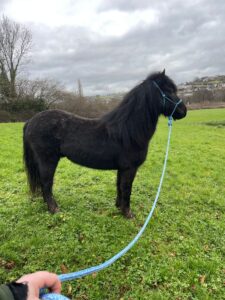
Here is Buzz, the cutest Dartmoor pony, who was completely feral less then 5 months ago. His owner has worked so gently with him to gain his trust so we could fit him with his halter. She has said how she loves what little contact or movement from her gets a change from Buzz. No pressure, no harsh pulling, just feel.